A Toolkit to Go Beyond the Classroom (and College) for Trans and Non-Binary Students’ Success at the California Community Colleges
Training
1. Share online resources.
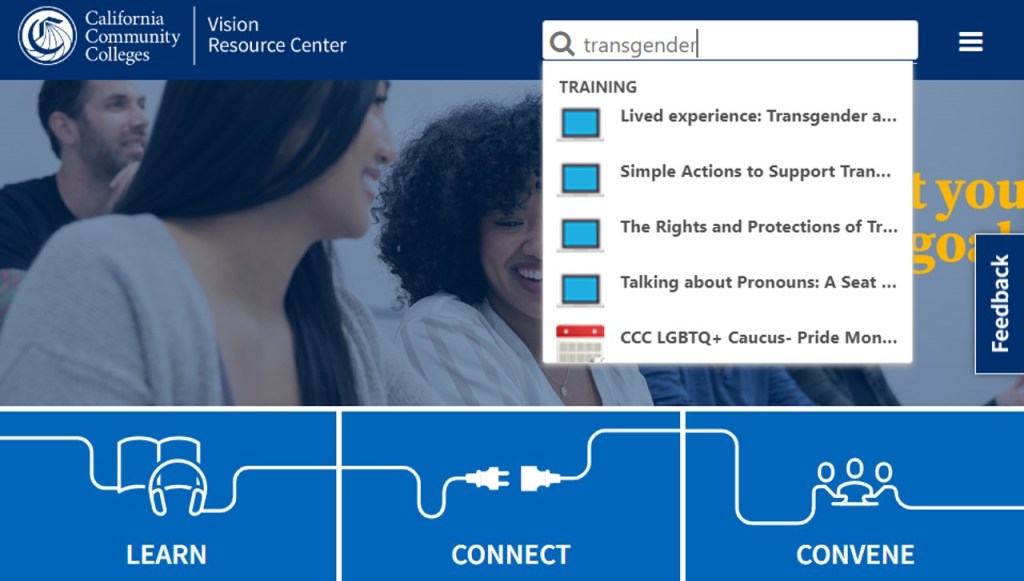
Find online resources to share with your campus community, particularly student and professional employees. The trainings should include things like current and outdated language, appropriate use of pronouns, trans and non-binary students’ campus experiences, and campus and local resources.
Trainings should align with current student needs and trends.
Trainings should be offered in a variety of formats that cater to different learning styles, including webinars, powerpoint slides, books/articles, Canvas shells, and podcasts.
Work with the college’ professional development team to offer training opportunities that meet Flex (Equity) requirements.
Even better – a four-part course called “LGBTQ+ Student Success: Identity, Intersectionality, and Advocacy in Education” is offered through the California Virtual Campus Online Network of Educations in the Vision Resource Center. Stay tuned for the next course opening!
2. Create or host a campus training for employees.
Create or host a campus training (in-house or contracted out) that can be incentivized through offering the training as part of annual required training hours for faculty and/or classified professionals.
Create or host a separate campus training for student employees and other student leaders, as they are often the first point of contact to their peers. Separate student and professional employee trainings are recommended because:
Roles are different, and thus different training topics are needed for each group.
Participants might not feel comfortable asking questions or sharing personal stories depending on whose in the room, considering supervisor-supervisee, and student-teacher, and mentor-mentee dynamics.
Professional employees need space to ask questions that might be offensive with a genuine goal to learn and do better, and students don’t need to experience professional staff going through that process.
Completion certificates or stickers should say, “Completed Ally/Safe Zone Training” instead of simply “Ally/Safe Zone”. We can never guarantee that someone will be an Ally or a Safe Zone to all students with marginalized genders and sexualities, and a 1-4 hour training is not enough time to give them that distintion.
3. Advocate for mandatory training.
Mandatory training would create consistent opportunities for all employees on campuses to have at least a minimum understanding of issues impacting trans and non-binary students and how to best support them. Colleges should work toward implementing mandatory training for all new, full-time hires – faculty, classified, and administrators – with recertification required every 2-3 years. Training should be incentivized for part-time hires. Trainings could be standalone, or included as part of already-required Title IX- or sexual harassment- related trainings.
There are always pros and cons to this, as the people who don’t want to be there could impact the experience for the people who do want to be there. This could be mitigated by having an online training module that employees must complete.
To be most successful, first get buy-in from key stakeholders, including upper administration, department chairs, and union leadership. Presentations to the Board and/or public comments can show widespread support for this requirement.
Ultimately, the Board of Trustees would likely need to approve the new requirements before they can be implemented.

 TRANScend Toolkit