
1. Find local providers to offer gender-affirming therapy and psychiatric care and make these resources visible through social media, a weekly newsletter, or posted in an LGBTQ+ campus center.
Make sure that the providers are willing to write gender validation letters if required to access aspects of physical health care related to gender transition. Create a referral list. This list should also include resources for gender-affirming treatment providers/centers for substance abuse/addiction, eating disorders/disordered eating, PTSD, depression, anxiety, and suicidality, which are all disproportionately experienced by trans and non-binary people.
Example of Resources in a newsletter, using mailchimp.com
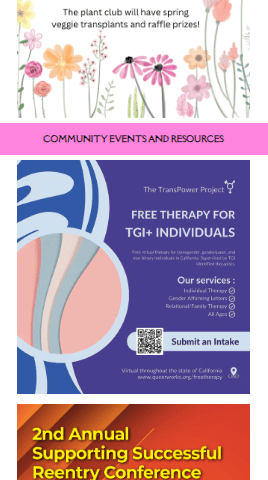
Example of Resources on a Website:

2. Create an MOU.
Create an MOU with those providers to offer services on campus and/or to dedicate a certain percentage of time or number of individual clients to local community college students, paid for by the college. Group therapy could also be explored here.
While every college is different, an MOU typically outlines the services/resources provided by both the partnering organization and the college. The MOU is signed first by the partnering organization and submitted to the college along with a copy of the insurance, liability waiver, and any additional documents that college requires. This all gets routed to the college VP overseeing that area and Legal Council for review and signature. A copy of the fully-signed document is then given to the partnering organization, at which time implementation can begin as specified in the MOU. Be sure to check with your college to follow their exact process!
See here for an MOU template: https://www.cccstudentmentalhealth.org/docs/CCC-MOU-Planning-Guide-and-Template.pdf

3. Train on-campus mental health care providers.
Train on-campus mental health care providers in gender-affirming practices, including writing gender validation letters if required to access transition-related physical health care. This training could be completed more informally through local providers, or more officially through conferences or webinars for Continuing Education Units or certifications.
Here are three training options to get you started!
- *online* https://www.thejunipercenter.com/february-live-webinar-trans-affirming-letter-writing-101-the-basics/
- *online* https://workshops.genderhealthtraining.com/courses/mghe-2024
- *in person* https://bhsd.santaclaracounty.gov/services-group/lgbtq/lgbtq-trainings
- *in person* https://trans.health/trainingacademy/
Relevant Research
Nearly one-third of trans people reported experiencing severe psychological distress, 2.5 times greater than the rate of the general population. (James et al., 2016). 41% of trans people have attempted suicide in their lifetime, comparted with 1.6% of the general population (Grant et al., 2011). For about 60% of trans students, experiences of discrimination and harassment led to at least one suicide attempt (Seelman, 2016).
When seeking help:
– 19% of trans people reported being refused health care
– 50% had to teach their health care provider about trans issues
approximately 1/3 reported postponing health care due to past discrimination (Grant et al., 2011)
– Many trans students specified that negative experiences with on-campus mental health providers were a factor in their decision to leave college (Goldberg et al., 2019b)
With little to no support tailored to their needs, trans folks employed a range of coping strategies:
– Positive coping such as self-exploration and self-acceptance
– Maladaptive coping such as social withdrawal and hiding their true self (Owens et al., 2023)
– Higher rates of smoking, drug, and alcohol use (Greathouse et al., 2018)
– One study found that trans people reported using illicit drugs, marijuana, and/or nonmedical prescription drugs at nearly 3x that of the general United States population (James et al., 2016)
– Higher rates of eating disorders as compared to cisgender students (Diemer et al., 2015). This may stem from a misplaced attempt to take back some control of their body, or as another way to escape it.
Maladaptive coping, while providing surface-level temporary relief and escape, ultimately only exacerbates the problem. This can lead to a further decline in health and academic success, especially for those at community colleges that lack those opportunities for support and community.
 TRANScend Toolkit