
1. Start with one or two classes.
Choose the first classes that would be important for students in a learning community. “English 1” and “Intro to College” are examples. Meet with the department chair(s) for those courses, and ask that they hold one section of each class specifically for trans and non-binary students, or with LGBTQIA2+ students more broadly.
The learning community classes should be taught by similarly-identified faculty, with queer and trans content as the sole curriculum
2. Expand the Learning Community.
Expand the Learning Community to additional courses and supports, including learning community-specific mental health support, academic counselors, tutors, transfer assistance, mentorship program, etc.
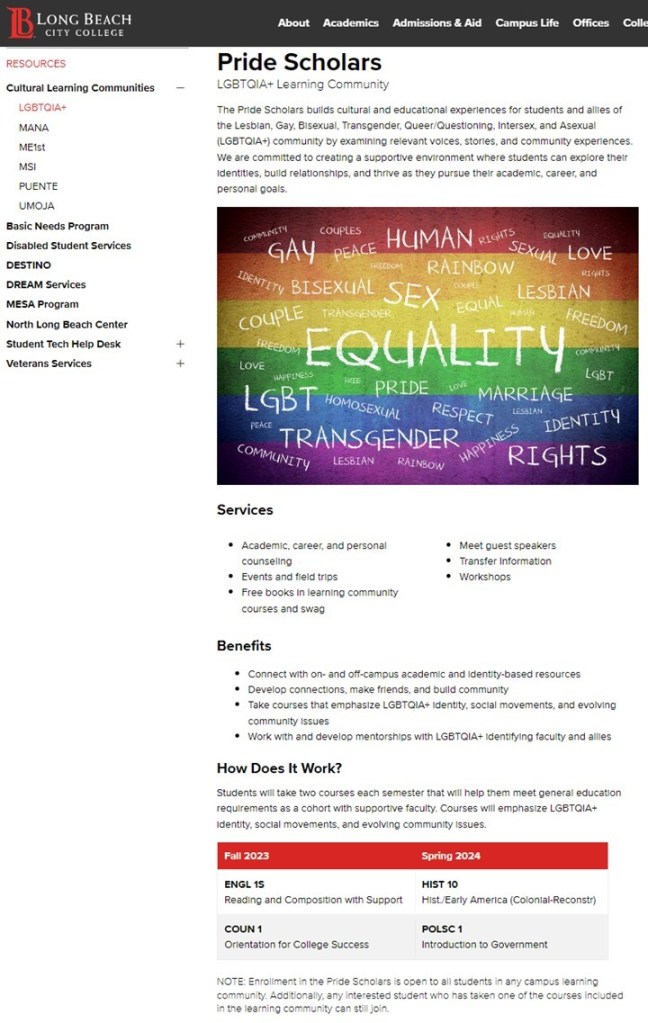
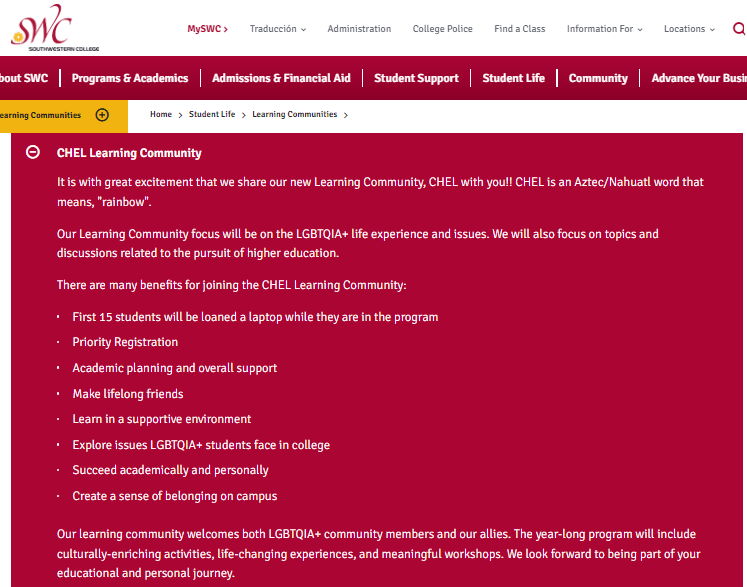
3. Continue to Grow.
Continue to grow the learning community until students can take all of their general education courses together. Ideas include:
- English: English 1A and English 1B
- Math: Statistics
- History: LGBTQIA2+ History
- Ethnic Studies: QTBIPOC Culture in the US and Around the World
- Biology: The [Accurate] Biology of Sex and Gender…What We Know So Far
- Psychology: Human Sexuality
- Sociology: Sociology of Sex and Gender
- Communication: Interpersonal Communication or Public Speaking
Relevant Research
Learning communities can be one way that trans students can create “chosen family” for academic and non-academic support (Bockting et al., 2013; Inderbinen et al, 2021; Levin et al., 2020).
57% of trans people reported experiencing significant family rejection, which took a significant toll on their mental health (Grant et al., 2011; Platt et al., 2022). Trans students nationwide are four times more likely to decide to go to college out of the city or state that they grew up (O’Neil et al., 2022). However, many trans and non-binary community college students remain local, taking on the additional stressors of continuing to live with family in unsupportive spaces, needing to code-switch between gendered presentations daily, and navigating through the risk of losing housing and financial support. Among trans students who leave college, a lack of family support is listed a core reason (Goldberg et al., 2019b).
For Latine students – those born in or with ancestors from Mexico, Central America, and South America – this includes queering the idea of familismo, or the strong impact of family that is crucial for Latine student success (Azpeitia & Bacio, 2022). This is especially important as many community colleges in California are “Hispanic Serving Institutions” with a high percentage of Latine students, and equal proportions of Latine non-binary students (California Community Colleges Chancellor’s Office Datamart).
 TRANScend Toolkit