
1. Find local providers.
Find local providers to offer gender-affirming health care and create a referral list. This list should include primary care, sexual health care, hormones, gender-affirming surgery, or other health-related services such as hair removal. The care provided should be in alignment with current WPATH standards. This includes gender-affirming treatments that are consent-based, without requiring a gender validation letter from a therapist or a “live full-time” requirement. With regard to surgery, requirements for a specific length of time on hormones should only be allowed if medically necessary.
Here are some of the various health care needs that should be available to trans and non-binary people, as specified within the WPATH Standards of Care, Version 8 (pp. S5, S18, S125)
- Chest, breast and genital gender-affirming surgeries
- Tracheal shave/reduction
- Facial feminization surgeries
- Lipoplasty/filling for body masculinization or feminization
- Body contouring
- Hair removal, such as electrolysis, laser treatment, etc.*not as a part of reconstructive surgery
- Hair removal required for reconstructive surgery
- Hair transplant
- Voice modification surgery
- Voice modification therapy
- Nipple reconstruction or tattooing
- Travel and lodging expenses
- Primary care
- Reproductive and sexual health care, including free birth control, internal and external condoms, dental dams and finger condoms, Plan B, PreP and PEP, and STI testing
- Mental health care
If your campus has a Cosmetology or Esthetician Program, try to partner with them for gender affirming hair cuts, manicures/pedicures, facials, hair removal, and makeup tips. This could be through events and/or vouchers for services.
2. Create your own, or host a workshop.
Partner with a community organization, a gender-affirming medical care facility, or a local insurance representative to hold workshops on accessing gender-affirming health care and knowing how to work through the insurance system.
Here is a resource to get started: https://transhealthproject.org/
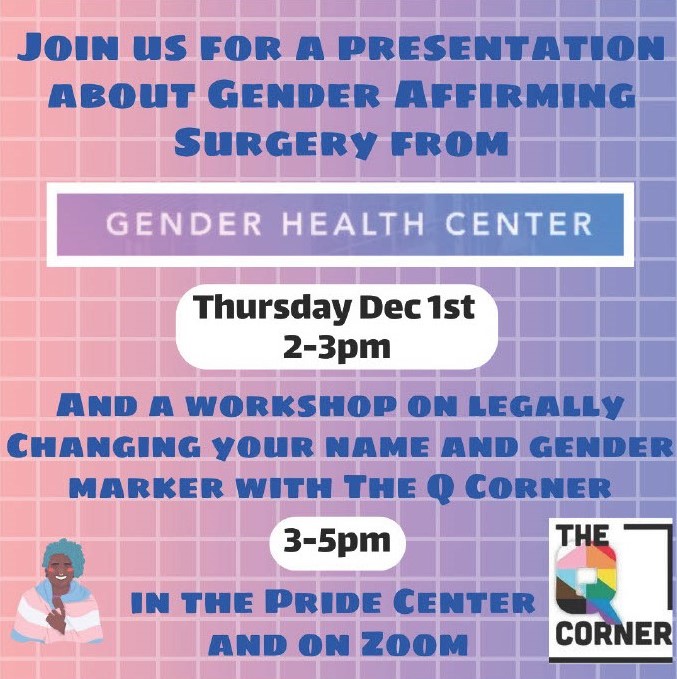
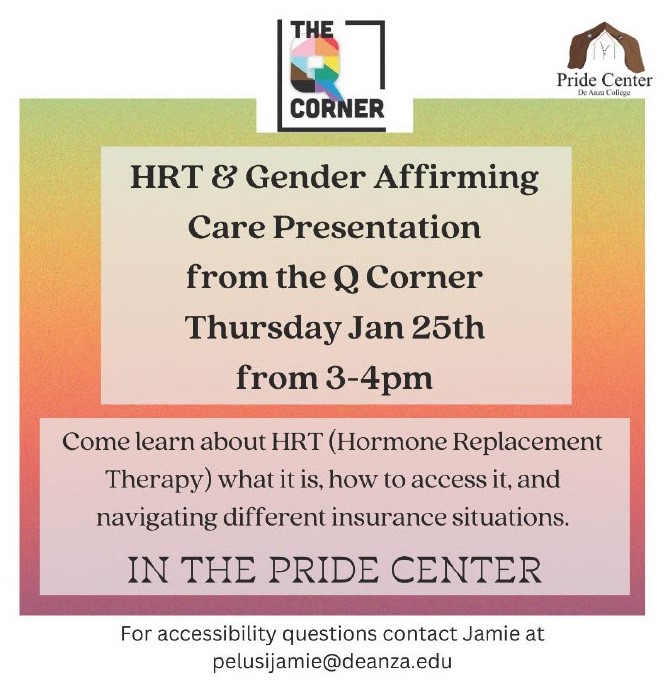
(DeAnza College, in partnership with a local organization)
https://www.instagram.com/p/C2diIvwr_TG/
https://www.instagram.com/p/ClhFOvuvFsD/
Historically, many insurance plans had broad exclusions for all transition-related health care. California law now requires Medi-Cal and all other state-regulated health plans to cover gender-affirming care that is deemed medically necessary. The problem is that some providers continue to consider gender affirming procedures cosmetic, and thus excluded from coverage. Private insurance companies may still have specific exclusions, using language such as “services related to sex/gender change” or “all procedures related to being transgender/gender identity disorder/gender identity dysphoria”. Students with private insurance should check their insurance companies’ complete terms of coverage.
3. Train on-campus health care providers in gender-affirming practice.
Depending on your current level of health center staff, this could include training:
- Doctors, nurse practitioners, and/or physician assistants to prescribe hormones and PrEP and PEP, and make referrals to local surgeons
- Doctors, nurse practitioners, an/or physician assistants to administer/train clients in safe testosterone injections, as well as inclusive bedside manner
- Front desk/administrative staff to provide an inclusive, welcoming health care environment regarding things like names on records, inclusive pamphlets, posters, etc.
This training could be completed more informally through local providers, or more officially through conferences or webinars for Continuing Education Units or certifications.
The WPATH Foundations in Transgender Health training can help providers learn more about trans healthcare in general – it is a great place to start!
For more advanced and/or clinical training, click on the logos to learn more about the following in-person opportunities:
4. Secure grant funding.
Work toward securing grants that would allow students to apply for funds to go toward gender-affirming health care costs not covered by their insurance. While grant funds are ideal, no-interest loans with affordable repayment plans could also be provided.
Relevant Research
Federal law now prohibits discrimination against transgender individuals in health insurance coverage, states across the US continue to restrict or prohibit gender-affirming health care, including specific exclusions in health insurance coverage.
Sometimes, any psychological distress present for a trans person would cause a provider to not provide that gender validation letter (MacKinnon et al., 2020). Yet, gender dysphoria is a cause of great psychological distress (Dhejne et al., 2016; Galupo et al., 2020; Lindley & Galupo, 2020; Nunes-Moreno et al., 2022), and such a letter would aid in accessing the medical care that would have a significant positive effect on mental health outcomes and quality of life overall (Dhejne et al., 2016; Swan et al., 2022).
 TRANScend Toolkit