

Language is always changing, and so are we.
Below are some helpful terms to know, used throughout the Toolkit.
Persistence
Continued course enrollment from one semester to the next
Retention
Continued course enrollment from one year to the next
Equity
The work to lessen the gaps caused by generations of accumulated disenfranchisement among marginalized communities. Practically, this means distributing resources and opportunities among groups in such a way that lessens those gaps, developing teaching practices that are universally designed and culturally relevant, and gathering both quantitative and qualitative data on a regular basis to aid in identifying and addressing any continued gaps.
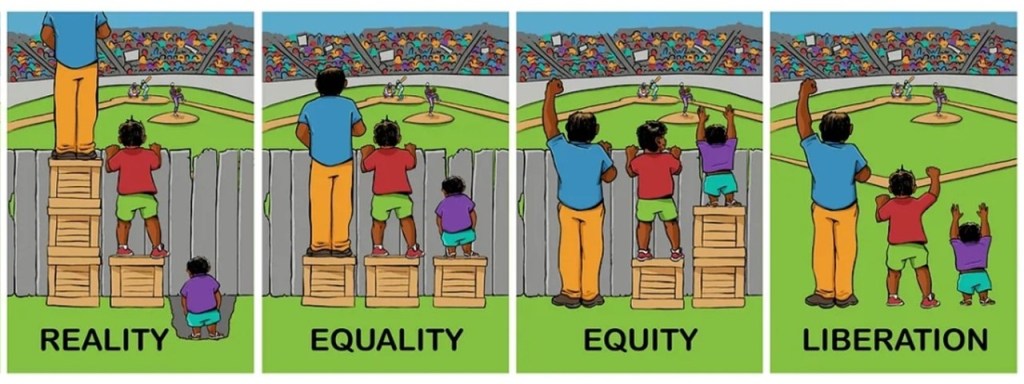
(Original Graphic Courtesy of The Center for Story Based Strategy)
Universal Access/
Universal Design
Creating infrastructure, policies, programs, documents, signage, etc. in a way that the very most amount of people can use them without added accommodation.
Examples include:
- eliminating outside stairs and curbs and having only ramps with slight incline and yellow tactile paving to indicate end of sidewalk/beginning of road
- all automatically-opening doors; or, if doors must be manual, providing a large button that can be pushed at multiple heights and with little dexterity needed
- seating without sides/arms, so that they can accommodate all body sizes
- desks that are not connected to chairs and that are height adjustable that would work for everyone regardless of whether they right with the left hand, right hand, feet, or mouth
- providing assignments with a specific focus, but allowing multiple ways of demonstrating understanding of that course content (paper, film, poem/song, powerpoint, painting, etc.)
- providing digital, physical, and audio text available in multiple languages spoken by students at that institution
- having ASL, Spanish, and other language translation available at all events, so that anyone can choose to attend an event last minute and know that they can access the content
- all signage with high contrast colors and braille.
- college attire offered in the largest range of clothing sizes possible (typically XS-6X, but should be able to get them up to 10X)
- dining hall food options that always include multiple vegan, gluten free, no added sugar/sweetener, allergen-free options
Intersectionality
Coined by Kimberlé Crenshaw, it is the recognition that people’s multiple identities – actual and perceived – shape their overall experiences in society. For example, Black trans women’s experiences lie at the intersections of race(ism), sex(ism), and trans(phobia), along with any other identities they hold and systems of privilege/oppression at play surrounding those identities. As such, their racialized experience differs from that of trans women of other races/ethnicities. Further, the experiences of Black trans women who are citizens of the United States vary from those of undocumented trans students in the United States. While documented Black trans women experience much oppression due to racism, sexism, and transphobia, they do have privileges that undocumented Black trans women don’t have. Wealthy Black trans women, such as Laverne Cox or Janet Mock, may similarly experience oppression based on how others perceive them, their access to wealth provides them many privileges today that they themselves did not have prior to their celebrity success.
Sex Assigned at Birth
A designation often based often on one’s genitalia in utero or at birth, but also informed by chromosomes, hormones, and other biological factors. Sex is often socially constructed into two categories – male and female – based on ambiguously assigned characteristics. (Think about this: It all comes from the same tissue in the womb, so at what length does a clitoris become a penis? Who determines that number?) However, all bodies are different, and so “intersex” is a term for people whose bodies don’t fit squarely into these binary sex categories.
AFAM: Assigned female at birth
AMAB: Assigned male at birth
Gender
A social category linked with, but completely separate from, sex. In the United States and many European and colonized countries, gender is socially constructed into two categories – man and woman, boy and girl. It’s tied into the words we use (woman, boy, transgender, non-binary, etc.), our relationships among each other (auntie, brother, abuelo), the kinds of toys kids should play with and what they should be when they get older, the restrooms we use, what deodorant and razors we should use, etc. In many indigenous communities around the world, gender has always gone beyond the binary.
Gender Identity
A person’s innate sense of their gender and the word(s) used to describe that.
Gender identities may conform closer to a binary gender, as in the case of trans women and trans men, or they may fall outside of those binary distinctions, as with non-binary or genderfluid people.
Gender Expression
How someone expresses themselves externally, including hair length and style, clothing, makeup and accessories, pitch and cadence of voice, style of walk, even whether they cross their leg at the knee or their ankle. Gender expression is used to convey gender outwardly. Ideally, this can be done authentically, but too often, people express their gender in other ways for safety, power, maintaining family dynamics, other people’s comfort, etc.
Gender Dysphoria
Feeling a disconnect between your body and your gender that causes great distress and negatively impacts daily life.
Cissexism/ Cisgenderism/ Genderism
The system of oppression that privileges cisgender men and women and marginalizes/disenfranchises transgender, third gender, and gender non-conforming people in laws and policies, infrastructure, institutional practices, and day-to-day interactions
Transmisia
The hatred of transgender people, often resulting in prejudiced beliefs, biased attitudes, discriminatory laws and behaviors, and oppressive systems.
This term is preferred over “transphobia” as it is not a true phobia causing great anxiety and distress to one’s life.
Read more about transmisia here: https://www.plannedparenthood.org/learn/gender-identity/transgender/whats-transphobia
Gender Euphoria
An elated feeling when one’s physical expression (including body and/or appearance) aligns with their gender, or when one’s gender is recognized and respected by others.
QTBIPOC
Queer (and) Trans Black, Indigenous, (and other) People of Color.
Trans and Non-Binary
An umbrella term to encompass all students whose internal sense of gender does not align with the sex and gender that they were assigned at birth.
It is important to note that individuals and cultures may have their own terms to describe their gender and/or sexuality. See “Two Spirit” below.
Third Gender
The gender binary is a relatively new, and very colonial, way of understanding gender, as is the term transgender. People have existed outside of a strict, two-gender system as far back as humans have uncovered thus far. These include the Muxes of Oaxaca, México, the fa’afafine and fa’afatama of Samoa, and the hijras of India. While each culture has a unique understanding of gender and sexuality specific to them, third gender people historically held highly spiritual roles in society, embodying both masculine and feminine energies. Colonizers forced their binary understanding of gender onto the societies they colonized. Today, third gender people globally face much discrimination.
Two Spirit
Similar to third gender, Two Spirit is a term created by Myra Laramee (Cree) in 1990 to have intertribal language for “another gender role believed to be common among most, if not all, first peoples of Turtle Island (North America)” (Montiel, 2021; Two Spirit Society of Denver, 2011). Individual nations may have their own culturally-specific language, such as the Nadleeh/Nadleehi of the Diné (Navajo) people, the wíŋkte of the Lakota people, and the Ihamana of the Zuni people.
Two Spirit people also held highly spiritual roles in society, and have experienced much discrimination post-colonization.
Masculine of Center
A term specific to communities of color, particularly Black communities, to describe people assigned female at birth whose gender identity and/or expression leans more masculine. This term was coined by B. Cole of the Brown Boi Project, and can include a wide range of identities such as butch, stud, aggressive/AG, dom, tomboi, etc.
*Note: feminine of center can be used by people assigned male at birth who lean more feminine, but it is far less frequently used.
Trans Woman, Trans Man
Identity terms. A trans woman is a woman who was assigned male at birth, and a trans man is a man who was assigned female at birth. May also see them written as transwoman and transman, often when one’s identity of trans and woman/man is more closely connected.
*Note: Sometimes, MTF (male-to-female) is still used by transwomen and FTM (female-to-male) is used by transmen. It is not as common today as trans communities have tried to shift focus from biological sex to gender.
Transfeminine, Transmasculine
Terms for folks assigned male at birth whose gender identity and/or expression is more feminine in nature (transfeminine) or folks assigned female at birth whose gender identity and/or expression is more masculine in nature (transmasculine), but who may not identify as woman or man. These folks may also use other gender identity terms as well.
Transition
A process of living in one’s authentic gender. Transitioning looks different for everyone, and may include social transition (using a new name and/or pronouns, or altering clothes, hair, body movement, voice), medical transition (undergoing medical or surgical processes to alter one’s body, including hormone replacement therapy or gender-confirming surgery), and legal transition (changing one’s legal name and/or gender on government and identity documents). Trans and non-binary people may choose to undergo some, all or none of these processes.
Binding and Tucking
Methods of compressing chests (binding) or external genitalia (tucking) to achieve a more gender-affirming appearance
Coming Out
Coming to terms with one’s own gender, and letting others know. Coming out is a deeply personal choice, and one that can be made each time a person meets someone new, someone “forgets”, or an identity label shifts. Many factors are at play in a person’s decision to come out, including safety, comfort, trust, and readiness. Coming out should not be expected of anyone, and is not the “end goal” to be part of LGBTQIA2+ communities.
Outing
Letting others know of a person’s trans or non-binary gender identity without their permission. Outing can have serious consequences on someone’s safety, employment, housing, family or religious involvement, and more due to the effects of genderism and transmisia.
Misgendering
Deadnaming
Misgendering: using the wrong pronouns or gender identity label for someone, intentionally or unintentionally.
Deadnaming: using one’s previous/legal/birth name (now called deadname), intentionally or unintentionally, rather than their chosen/lived name.
Woman/Man of Trans Experience
A term often used by people who identify strongly/solely to a binary gender of man or woman, but still want to recognize their experience of gender transition.
“Push-out” (as opposed to “drop-out”)
Puts the onus on institutions to work to reduce and eliminate the barriers that impede trans and non-binary students’ academic success. Students do not simply choose to drop out; it is often institutional and other barriers that push them out.
When students do not complete a course, it is likely due – at least in part – to factors outside of the classroom which the student has no control over and is negatively impacted by. When students decide to leave college, it is not arbitrary. It is likely due to a confluence of outside factors – in and out of the classroom – that have negatively impacted them or which need to be prioritized higher than education at that moment.
 TRANScend Toolkit